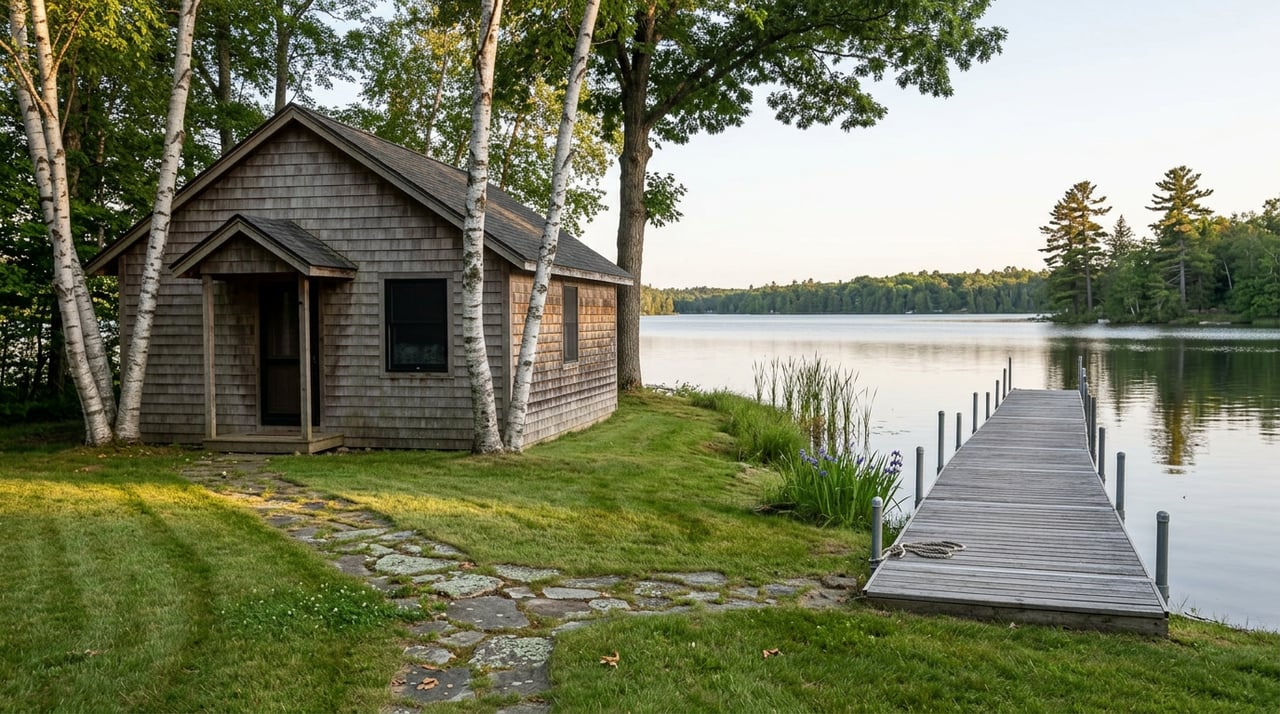
A listing agent describing a Fish Lake property put it plainly: buyers get the boating, the fishing, and the summer view, "without the high shoreline taxes." That line does more to explain the Mora-area lake market than any median price ever could. It tells you the real product being sold near the water is not square footage. It is feet of frontage.
If you have been shopping Kanabec County by median price alone, you have been looking at the wrong number.
Why the countywide median hides the real story
As of March 2026, Kanabec County's median home sale price sat at $247,000, up 9 percent year over year, with a median sale price of $173 per square foot, according to Redfin. In Mora itself, Redfin's May 2026 city-level data put the median sale price at $244,853, up 3.1 percent from a year earlier. Those numbers describe a modest, steady small-town market, and for homes on standard in-town lots, they are a fair starting point.
They fall apart the moment you cross into lakefront territory. Bare, unimproved lakefront acreage in Kanabec County averages $335,470, according to Land.com's listing data. That is not a built home. That is dirt and shoreline, priced higher than the median finished, move-in-ready home in town. General land listings elsewhere in the county, by comparison, average about 21 acres for roughly $253,300. The gap between those two land prices is the shoreline premium, and it is the same premium that shows up in every waterfront listing on Knife Lake, Ann Lake, and Mora Lake.
Once you see that gap, the county median stops being useful for anyone shopping the water. Mora is not one market. It is two, and the dividing line is the shoreline itself.
Lakeshore ownership and lake access are not the same product
This is where the Fish Lake listing's promise of water access without shoreline taxes makes sense. Minnesota recognizes a real legal distinction between owning lakeshore and holding an easement that lets you reach a lake someone else owns. A Minnesota real estate attorney's overview of lake access easements, published by Dahle Law, notes that an easement can grant the right to cross land to reach the water for boating or swimming, but it does not automatically include riparian rights, meaning the right to place and maintain a dock. Those rights only transfer if the easement document specifically says so.
Here is the practical difference laid out side by side:
| True lakeshore | Lake access easement | |
|---|---|---|
| Owns frontage | Yes | No |
| Riparian rights (dock, boat lift) | Yes, by default | Only if the easement specifically grants them |
| Typical cost position | Premium, tied to frontage footage | Lower, closer to inland home pricing |
Neither option is better in the abstract. A buyer who wants weekend access to Knife Lake without carrying a lakeshore tax bill might prefer the second column entirely. A buyer planning to keep a boat at their own dock for decades needs the first. The mistake is not knowing which one you are looking at before you write an offer.
Why assessed values lag the market
One more wrinkle worth knowing before you get attached to a number on a listing sheet. Minnesota's assessed values trail the market by about two years, a timing detail described in Star Tribune reporting on the statewide assessment cycle. The value notice a seller received this spring reflects sales data from roughly two years earlier, not this summer's activity.
That means a lake that has quietly gotten more popular in the last year or two, whether through a new business drawing weekend traffic, a stretch of good fishing reports, or simple word of mouth, may still be assessed on outdated comparable sales. The tax bill you see at closing might understate what next year's reassessment will bring, particularly on a lake where recent sales have been running ahead of the assessor's existing comps. It is worth asking directly whether recent sales on that specific lake have outpaced the current assessed values, rather than assuming this year's bill is a reliable guide to next year's.
What this looks like on the ground in Kanabec County
The named lakes make the pattern concrete. A recent listing on Knife Lake advertises a home on a private peninsula with roughly 230 feet of shoreline, and that footage, not the floor plan, is the headline feature. On Mora Lake, one current listing leads with 100 feet of shoreline behind a home that just went through a full top-to-bottom renovation, while a separate listing repositions a mixed-use building dating to 1898 that sits directly on the lake's shore. Different properties, same pattern: the water does the pricing work. Even the commercial market reflects it. A restaurant and bar situated directly on Ann Lake's shore is marketed on its waterfront position as much as its business, because in Kanabec County, that shoreline is part of the asking price.
Meanwhile, Mora's town center is not standing still while the lakes get the attention. The Mora Economic Development Authority is actively marketing a downtown commercial corner for redevelopment, and the Mora MainStreet Arts and Cultural Compound continues its work on the historic downtown district. That in-town investment matters for buyers who want the small-town walkability of Main Street over shoreline footage, and it is part of why the two markets, town and lake, are worth evaluating on their own separate terms rather than blended into one countywide average.
A short list before you write an offer near the water
- Ask whether the property has deeded frontage or an access easement, and if it is an easement, ask to see whether the document specifically grants riparian rights
- Request the current tax statement and ask the listing agent whether recent sales on that specific lake have run ahead of the assessed value
- Compare the parcel's shoreline footage against similar recent sales on the same lake, not the countywide median
- If buying bare land, price it against other lakefront land in the county, not against built homes in town
The median price tells you what a typical transaction looked like last month. It does not tell you what you are actually buying when the parcel touches water. In Kanabec County, that answer lives in the shoreline and the deed language, not in the square footage of the house.
If you are weighing a lake purchase near Mora against a home in town, or trying to make sense of a tax statement that does not seem to match what you are seeing on paper, Team Lundeen can walk through the specific parcel with you before you make an offer. Let's find your way home. Request a free home valuation and we will help you read the numbers that actually matter.
This article is general information, not legal, tax or financial advice. Consult a qualified professional about your situation.